Executive Summary
In this white paper, we examine how to design viral clearance studies that balance scientific rigor with operational efficiency. By highlighting common pitfalls and illustrating how modality-specific considerations shape virus panels, we aim to provide developers with practical, regulatorily aligned best practices for efficient, successful viral clearance studies.
Modern biologics have a strong safety record thanks to three key pillars: material characterization, batch release testing, and viral clearance studies. Among these, viral clearance studies are critical because they evaluate how effectively a manufacturing process removes or inactivates potential viruses, ensuring both regulatory compliance and patient safety.
With the evolution of advanced therapies, updated guidelines like ICH Q5A(R2) now expand expectations beyond traditional biologics to include modalities such as gene therapies. These guidelines emphasize a risk-based and phase-appropriate approach, meaning studies must be tailored to each product’s development stage and manufacturing process.
In addition, many developers face similar challenges when designing viral clearance studies. In this paper we identify five common pitfalls and solutions for avoiding them. We also know that viral clearance is not universal—different biologics require different approaches, and we outline those modality specific differences.
Finally, we review how to design efficient and regulator-ready viral clearance studies by applying what we know to be best practices including the use of high-quality virus stocks and robust assays and how to leverage historical and platform data carefully.
Continue reading to access the full white paper or download your copy now.
Strengthening a Critical Safeguard
Modern biologics have maintained a strong viral safety record for decades, supported by the “three pillars” of viral safety: material characterization, batch release testing, and viral clearance studies.1,2 While characterization and release testing detect known contaminants, they are limited by the sensitivity of direct detection assays.1 Viral clearance studies are the critical third pillar, evaluating the manufacturing process itself by introducing model viruses to quantify how effectively specific steps remove or inactivate them.1,3 This characterization is a pivotal driver of regulatory confidence and patient safety.
The need for scientifically justified viral clearance studies has gained renewed importance as biotherapeutics continue to develop. The recent update to ICH Q5A(R2)4 extends guidance to advanced therapies while reinforcing standards for protein biologics. Although viral clearance science is relatively well established, the design of these studies still must occur under real-world pressures. A program’s unique process architecture, helper virus profile, and capsid properties are all factors that may affect the study scope, including the number of clearance steps and model viruses required.4
About Minaris Advanced Testing
This white paper draws directly from Minaris Advanced Testing’s long-standing experience executing viral clearance studies. With over 40 years of biosafety testing experience and 25 years of manufacturing advanced therapies, we have accumulated a practical understanding of how clearance studies behave in real processes.
Our capabilities rely on high-purity, high-titer virus stocks and a comprehensive analytical platform. To date, we have completed more than 3,000 viral clearance studies with zero regulatory rejections. We draw on this blinded internal dataset to guide study design, anticipating pitfalls and calibrating virus panels based on real performance data. The following guidance reflects that experience, offering insight into designing studies that are defensible, efficient, and well-matched to each program’s stage.
Regulatory Expectations Evolve to Encompass Advanced Therapies
The 2023–24 revision of ICH Q5A(R2)4 represents the most significant update to viral safety expectations in two decades.2,4 For monoclonal antibodies (mAbs) and wellcharacterized proteins, the guidance largely reaffirms long-standing principles: testing must demonstrate robust orthogonal reduction across relevant process steps.4,5 Importantly, Q5A(R2) also formalizes the concept of platform data for these proteins, allowing developers to reference historically consistent clearance mechanisms—such as low pH inactivation or viral f iltration—when justified by sufficient internal data and process comparability.4
For advanced therapies, including AAV produced via triple transfection or baculovirus systems, the revision addresses specific scientific complexities. The guidance emphasizes phase-appropriate design and the justification of virus selection, including helper viruses and capsid susceptibility to inactivation. Rather than prescribing one-size-fits-all criteria, Q5A(R2) directs developers to apply a risk-based rationale consistent with the product’s clinical stage.
Applying this guidance requires interpreting it within the context of each product’s unique manufacturing architecture. Effective study design aims to integrate regulatory alignment with real-world process knowledge to achieve outcomes that are both defensible and efficient.
Avoiding Common Real-World Pitfalls in Viral Clearance Studies
Viral clearance studies evaluate how effectively a manufacturing process can remove or inactivate viruses. These studies use two categories of challenge viruses defined in regulatory guidance: relevant viruses, which represent agents plausibly associated with the production system (e.g., helper viruses, host-cell viruses), and model viruses, which are well-characterized surrogates selected for their resistance profiles, stability, or structural similarity to potential contaminants.⁴ Both types play essential roles in establishing a scientifically justified virus panel.
Viral clearance studies are shaped by two types of uncertainty: the interpretive space created by evolving regulatory guidance, and the real-world constraints of development programs. Timelines, process maturity, facility availability, assay limitations, and the quality of virus stocks can all impact study feasibility and outcomes. These pressures may translate into cost overruns, schedule disruptions, unnecessary rework, or studies that fail to provide the intended level of assurance.
Drawing on decades of biosafety testing and thousands of executed studies, the following sections summarize the pitfalls we most frequently observe across modalities. These insights reflect practical, real-world challenges encountered during study design and execution—and highlight where targeted planning can prevent delays, reduce uncertainty, and support more efficient viral clearance strategies.
Pitfall 1
Treating Viral Clearance as a One-Size-Fits-All Exercise
A common pitfall—especially for small and midsized developers—is being steered toward a fully comprehensive, late-phase “Cadillac” viral clearance study when the program is still early in development. While the underlying science is consistent, an inflexible, all-inclusive package can strain limited budgets, extend timelines, and divert resources from other critical activities. Early clinical and exploratory programs rarely need the full breadth of commercial-scale requirements; what they need is a phaseappropriate approach that generates defensible data without overspending.
Solution
Phase-Appropriate Studies, Flexibly Executed
The most effective path forward is working with an organization that can right-size study scope to the stage of development— preliminary, Phase 1, or late-stage—while still ensuring regulatory confidence. Partners who take this approach evaluate the needs of the full program, offer flexibility in schedule and scope, and leverage historical data to avoid unnecessary work. This balance of scientific rigor, financial stewardship, and operational f lexibility helps developers—especially resource-constrained teams—advance programs efficiently without compromising the needed data.
Pitfall 2
Misaligning the Timing of a Viral Clearance Study
A persistent challenge in viral clearance planning is timing. Initiating a study too early can force developers to work with immature or incomplete process data, while delaying too long can lead to capacity constraints, rushed decisionmaking, and pressures that threaten downstream milestones and commercial runway. When timing is misaligned, programs often face incomplete data packages, unplanned rework, or repeated assays. Each adds cost, uncertainty, and avoidable delays.
Solution
Early Planning, Strong Communication, and Flexible Scheduling
The most effective approach is to begin planning well in advance of regulatory submissions and to maintain open communication with the contract organization throughout process development. Developers who share anticipated timelines, evolving process maturity, and potential risks early enable their partners to offer appropriate schedule flexibility while still ensuring regulatory alignment. When both sides communicate proactively and adjust scope based on phase and readiness, viral clearance studies can leverage mature process data, avoid unnecessary duplication, and produce high-quality, defensible results.
Pitfall 3
Poor-Quality or Low-Titer Virus Stocks Compromise Study Integrity
High-quality virus stocks are fundamental to viral clearance studies, which rely on spiking defined quantities of virus into scaled-down process steps. Within this experimental design, the purity, concentration, and characterization of the virus stock directly influence the observable performance of filtration, chromatography, and inactivation steps under challenge conditions. When the stock itself is suboptimal, even a well-designed study can yield misleading or non-representative results.
Poorly purified or poorly characterized stocks introduce unwanted impurities that can artificially foul filters, alter resin performance, or interfere with inactivation kinetics—distorting measured log reduction values (LRVs) and obscuring the process’s true clearance capability. Low-titer stocks pose an additional risk: because regulatory guidance caps allowable spike volumes, insufficient titer can lead to an underpowered challenge that fails to meaningfully stress the clearance step, potentially masking performance gaps or underrepresenting performance strengths.4
Solution
Use High-Purity, High-Titer, Well-Characterized Virus Stocks
The most reliable studies employ virus stocks that are generated and purified using robust methods and thoroughly characterized before use. High-purity stocks minimize non-viral contaminants that can confound process performance, while high-titer stocks ensure a rigorous infectivity challenge within permitted spike volumes. When paired with step-specific considerations—such as appropriate spike ratios and assay sensitivity— this approach strengthens data integrity and maximizes confidence in LRV outcomes.
Pitfall 4
Assuming Platform Data Will Automatically Satisfy Viral Clearance Requirements
ICH Q5A(R2) promises greater efficiency through the use of platform data for well-characterized unit operations (e.g., low-pH inactivation, viral filtration) for mAbs and other well-characterized proteins.4 However, this guidance is not a “rubber stamp.” The guidance requires substantial prior knowledge and a scientific justification that new process parameters (pH, temperature, filter loading) are comparable.⁴ In practice, developers may assume platform data will apply to their molecule, only to discover late in planning—or once a study begins—that their process differs enough to require additional experiments or validation. This mismatch can introduce unplanned cost, expanded scope, and schedule disruptions.
Solution
Evaluate Platform Data Applicability Early, Supported by Robust Prior Knowledge and Documented Comparability
The most effective strategy is to assess platform data suitability early—before finalizing study design—using historical data, risk assessment, investigational R&D studies, and process comparability analyses aligned with ICH expectations. Here developers benefit from working with organizations that possess large internal viral clearance datasets and mature assay characterization, which may enable more informed decisions about where platform data are appropriate and where product-specific studies remain necessary.
Pitfall 5
Assays that Constrain Achievable Log Reduction Values (LRVs)
The sample volume an assay can accommodate places a mathematical limit on the demonstrable LRV in a viral clearance study. If a purification step clears 6 logs of virus but the assay can only measure 4 logs due to volume constraints, the report will underrepresent the process’s safety. As a result, highly effective steps may appear to plateau at lower LRVs.
Infectivity assays are essential because they quantify replication-competent virus, a primary regulatory concern.⁴ However, commonly used TCID₅₀ assays may run up against limits due to their format, as well as practical constraints on test volume. These factors may in turn restrict statistical power at low virus concentrations and can cap measurable LRVs below the true clearance capability of a process.
Assay selection more broadly shapes how clearance data are interpreted. Misalignment between assay capability and expected clearance depth can lead to underrepresentation of process performance, unnecessary addition of unit operations, or avoidable repeat studies—outcomes that introduce delay, cost, and uncertainty.
Solution
Pair High-Quality Virus Stocks with Assays Capable of Large-Volume Testing
A more robust approach is to use wellcharacterized, high-titer virus stocks together with infectivity assays that can be executed at larger volumes. Increasing the volume of f iltrate or eluate tested directly increases the upper limit of quantification, often enabling measurement of LRVs one or more logs higher than small-volume formats allow. Assay strategies that incorporate large-volume testing—such as Large Volume Plaque Assays (LVPA)—may create a a truer picture of a step’s clearance capability and result in a more robust dataset for regulatory submission.
Designing Viral Clearance Studies Based on Therapeutic Modality
Modality plays a critical role to drive viral clearance strategy. While the principles of removal and inactivation apply broadly, the execution varies by product type. The updated ICH Q5A(R2) guidance reinforces this reality by formally recognizing modality-specific challenges, including for vector-based therapies and processes that use helper viruses, and by clarifying where scientific justification must adapt to product biology and process design.4
Modality affects which viruses are selected for the challenge panel, which unit operations are suitable to evaluate, and how clearance mechanisms—such as size-exclusion filtration, chromatographic partitioning, or pH-/detergent-based inactivation—should be interpreted under process-relevant conditions. The following subsections provide representative expectations and example virus panels for three major categories: mAbs, AAV produced via triple transfection, and AAV manufactured with baculovirus helper systems.
Viral Clearance Strategies and Panel Design for Monoclonal Antibodies (mAbs)
Viral clearance strategies for mAbs are the most mature and well-defined, supported by decades of regulatory precedent and a highly standardized platform of unit operations. Early-phase (Phase 1) studies generally evaluate two model viruses representing key clearance mechanisms:
Enveloped virus (e.g., MuLV): Used to demonstrate inactivation and removal via low-pH treatment and chromatography.
Small parvovirus (e.g., MVM): Represents a worstcase challenge due to small size and resistance to many inactivation methods; critically probes virus f iltration and robustness of downstream purification.
The unit operations typically evaluated—column chromatography, virus filtration, and a dedicated inactivation step (low pH or solvent/detergent)— are chosen because they directly contribute to virus removal or inactivation within the mAb platform process. Regulators expect at least one step to achieve strong parvovirus clearance (≥4-log), complemented by cumulative clearance.5,6
As programs progress to Phase 3 or commercial readiness, the virus panel expands to include a broader diversity of properties: genome type, enveloped or non-enveloped virus , particle size, and environmental stability. Later-phase studies often incorporate aged versus new chromatography resins, worst-case process conditions, multi-column trains, mass-balance assessments, and operatingrange tolerances. Virus filtration becomes a focal unit operation where regulators expect well-supported demonstration of small-virus removal under true process conditions.
Example mAb Virus Panel (with rationale):
MVM: Small, non-enveloped DNA virus; gold-standard worst-case parvovirus for filtration and inactivation stress.
MuLV: Large, enveloped RNA retrovirus used in safety-factor calculations and cumulative clearance justification.
Reo-3: Mid-sized, non-enveloped dsRNA virus; challenges chromatographic partitioning and filtration behavior.
PRV: Large, enveloped DNA virus; probes efficiency of envelope-targeting inactivation steps.
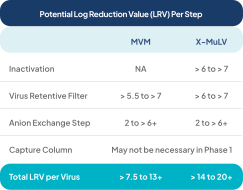
This figure shows the LRV range associated with common vira clearance steps in early development. The higher the LRVs, the fewer steps may be needed to evaluate during a viral clearance study.
Collectively, this panel spans a range of biological and physical properties, ensuring that the dataset challenges each clearance mechanism represented in the mAb process and aligns with long-established regulatory expectations for biologics.
Viral Clearance Strategies and Panel Design for AAV Products (Triple-Transfection / Non-Helper Systems)
Unlike mAbs, AAV manufacturing lacks a single, established model virus or set of required unit operations. As a result, ICH now places greater emphasis on modality-specific, risk-based justification rather than prescriptive panels.4 This makes panel construction more proactive. Sponsors must connect virus choice to real process risks.
For triple-transfection AAV processes, the panel must capture risks associated with cell banks, plasmid systems, media supplements, and any optional downstream inactivation or chromatographic steps. Across programs, regulators generally expect at least three viruses representing different sizes, structures, and resistance profiles. Viral filtration is typically included to remove larger viruses (e.g., helpers). However, because AAV capsids share the same size range (~20–25 nm) as small parvoviruses, standard retentive filtration cannot discriminate between product and this specific class of contaminant. Therefore, panel diversity becomes key for demonstrating robustness.
Optional additions (e.g., MuLV, PRV, or Reo-3) may be incorporated when processes include multiple orthogonal mechanisms such as chromatography or detergent steps.
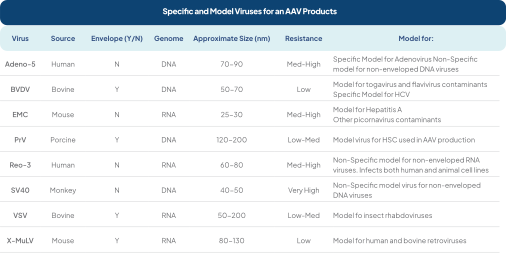
Example AAV Virus Panel (Non-Helper System):
Adenovirus – Medium-sized non-enveloped DNA virus, Relevant to helper functions and a plausible adventitious agent in plasmid-based systems.
SV40 – Medium-sized (~40–50 nm) non-enveloped DNA virus, and resistant to many inactivation mechanisms; effectively challenges f iltration and chromatography.
BVDV – Enveloped, smaller than adenovirus RNA virus; represents serum- or media-derived risks.
Triple Plasmid Transfection Product
Percentage of times Virus was requested:
Adenovirus
85%
BVDV
30%
SV40
92%
MuLV
70%
This table shows approximately how often we see certain viruses in panels for AAVs produced using triple transfection.
This type of panel aligns with ICH Q5A(R2) expectations for relevance, physicochemical diversity, and stepwise, risk-based justification—an approach that remains critical as AAV modalities continue to mature and standardize.
AAV Produced with Baculovirus Helper Systems
AAV produced in insect cells using baculovirus helper systems introduces a distinct viral-risk profile compared with mammalian, plasmid-based approaches. The use of a replication-competent helper virus (baculovirus) and an insect-cell substrate (typically Sf9) broadens both the number and diversity of potential adventitious agents. This elevated risk—reflected in the updated ICH Q5A(R2) guidance—drives the need for larger, more comprehensive virus panels and more detailed mapping of how each clearance step contributes to overall viral clearance.
ICH emphasizes that modality-specific risks must directly inform panel construction. In this system, those risks include:
Helper-virus carryover, requiring explicit demonstration of baculovirus removal or inactivation.
Endogenous insect-cell contaminants, notably VSV, which is a recognized risk for Sf9-derived processes.
Inability to use size-exclusion mechanisms to remove small, non-enveloped viruses (due to product co-purification)—necessitating additional reliance on inactivation or chromatographic clearance. Late-phase studies typically employ five-virus panels to reflect these diverse risk categories. Unit operations are selected based on their ability to provide orthogonal mechanisms of clearance— viral filtration, AEX chromatography, and detergent inactivation—and are evaluated with attention to mass balance and step-virus mapping, as helper- virus interference and cytotoxicity can affect assay readouts.
Example Baculovirus-System Virus Panel:
Baculovirus – Helper virus; large, enveloped, dsDNA virus; modality-defining risk requiring explicit clearance.
VSV – Insect-cell substrate risk; medium-sized, enveloped, ssRNA virus associated with Sf9 contamination.
SV40 – Small, non-enveloped, dsDNA virus; challenges filtration and inactivation steps.
PPV or Reo-3 – Small (PPV) or mid-sized (Reo-3), non-enveloped viruses; ssDNA (PPV) or dsRNA (Reo-3) genomes; provide additional representation where no single parvovirus surrogate applies.
MuLV – Medium-sized, enveloped, ssRNA retrovirus; supports cumulative clearance rationale and aligns with historical expectations.
Baculovirus as Helper Virus
Percentage of times Virus was requested:
Baculovirus
100%
VSV
100%
MuLV
75%
PPV
75%
Reo-3
75%
This panel addresses helper-virus relevance, insect-cell risks, envelope and size diversity, and the multi-mechanistic evaluation encouraged by ICH Q5A(R2)—providing a risk-based framework for baculovirus-derived AAV programs.
Considerations for AAV Virus Panel
International Council for Harmonisation of Technical Requirements for Pharmaceuticals for Human Use (ICH). ICH Q5A (R2). Guideline on Viral Safety Evaluation of Biotechnology Products Derived from Cell Lines of Animal Origin.
Buckwold VE, Beer BE, Donis RO. Bovine viral diarrhea virus as a surrogate model of hepatitis C virus for the evaluation of antiviral agents. Antiviral Res. 2003 Sep;60(1):1-15. doi: 10.1016/s0166-3542(03)00174-8. PMID: 14516916.
Conclusion
Designing a viral clearance study in the era of ICH Q5A(R2)4 takes a balance of scientific rigor and operational pragmatism. As outlined in this paper, the path to a successful submission lies in anticipating risks early, whether they stem from assay limitations, stock quality, or the unique architecture of a viral vector process. By adopting a phaseappropriate strategy and addressing modalityspecific concerns, developers can transform a complex regulatory obligation into a confident, efficient demonstration of patient safety.
At Minaris Advanced Testing, we apply over 40 years of biosafety testing experience to help sponsors navigate this process. We recognize that each development journey is unique, and we reject onesize-fits-all templates in favor of strategies tailored to each sponsor’s program and development phase. By leveraging our extensive internal dataset of over 3,000 executed studies, we can predict potential performance issues, troubleshoot anomalies before they cause delays, and design virus panels that align with real-world experience. Furthermore, our highpurity, high-titer virus stocks help ensure sponsors demonstrate the maximum possible Log Reduction Values (LRVs) inherent in their manufacturing process.
As a global organization integrating rigorous safety testing with the development and manufacture of advanced therapies, we offer a comprehensive vantage point on the lifecycle of a biologic. Whether supporting a monoclonal antibody or a novel viral vector, our teams work collaboratively to ensure that the viral clearance strategy is not just a standalone test, but a seamless component of your product’s journey to the clinic. We invite developers to partner with us to design studies that are scientifically robust, operationally efficient, and built on a foundation of proven expertise.
References
- European Medicines Agency. Guideline on virus safety evaluation of biotechnological investigational medicinal products. EMEA/CHMP/ BWP/398498/2005. February 1, 2009.
- International Conference on Harmonisation of Technical Requirements for Registration of Pharmaceuticals for Human Use (ICH). ICH Q5A: Viral Safety Evaluation of Biotechnology Products Derived from Cell Lines of Human or Animal Origin. 1999.
- Food and Drug Administration. Points to Consider in the Characterization of Cell Lines Used to Produce Biologicals. FDA; 1993.
- International Council for Harmonisation of Technical Requirements for Pharmaceuticals for Human Use (ICH). ICH Harmonised Guideline Q5A(R2): Viral Safety Evaluation of Biotechnology Products Derived From Cell Lines of Human or Animal Origin. Step 5. Adopted December 22, 2023.
- Brorson K, et al. Virus removal and inactivation by chromatography and virus filtration: benchmarking and lessons learned. PDA J Pharm Sci Technol. 2010;64(6):544-563.