As cell and gene therapies (CGTs) progress swiftly from early-stage development to commercial launch- often via accelerated or breakthrough designations – there is less and less room for error. Manufacturing timelines are compressed, technology transfers are more complex, and quality decisions made early can determine whether programs scale smoothly or stall under regulatory pressure.
In this environment, quality is no longer a downstream checkpoint. It is a strategic enabler of speed, reliability, and patient access.
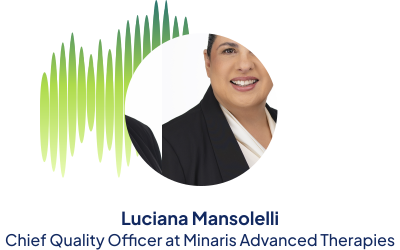
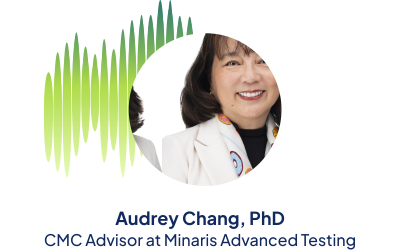
In a recent webinar, Dr. Audrey Chang, CMC Advisor at Minaris Advanced Testing, sat down with Dr. Luciana Mansolelli, Chief Quality Officer at Minaris, to explore how quality organizations can evolve to meet these challenges. Their discussion focused on practical, real-world perspectives – covering quality agreements, technology transfer, risk management, data integrity, and the role of QA in accelerated development pathways.
This article captures key moments from that conversation, along with live audience Q&A, highlighting lessons learned that are directly applicable to sponsors, CDMOs, and quality leaders navigating today’s advanced therapy landscape.
Leadership Interview
Chang: How should the role of Quality Assurance evolve for advanced therapies?
Mansolelli: Quality Assurance (QA) must evolve from being a gatekeeper of compliance to a co-architect of reliable, scalable manufacturing solutions. In advanced therapies – where a batch often represents a single patient – QA must integrate science, risk, and regulatory intent to enable speed without sacrificing control.
Quality should not be about saying “no.” It should be about designing systems where the right decision is obvious and repeatable across the organization. Ultimately, quality is not a function; it is everyone’s responsibility.
Chang: What are the biggest quality challenges impacting cell and gene therapy manufacturing today?
Mansolelli: There are three challenges that consistently rise to the top:
- Biological variability – Control strategies must be based on process knowledge, not batch counts. Lifecycle and concurrent validation, supported by proactive quality risk management, are essential.
- Contamination and cross-contamination risk – Living cells and viral vectors elevate both product and operator risk. Robust contamination control strategies, aligned with Annex 1 principles and favoring closed and single-use systems, are critical.
- Data integrity and long-term traceability – Advanced therapies may require traceability for decades. Digital systems must be validated early, with strong adherence to ALCOA+ principles and intentional data design.
Chang: What defines a robust quality agreement between a sponsor and a CDMO?
Mansolelli: A strong quality agreement goes far beyond listing roles and responsibilities. It must clearly define decision rights – who decides, who informs, and who approves – particularly when decisions directly affect patient timelines.
Key elements include ownership of deviations and corrective and preventive action plans (CAPAs) as well as change management and regulatory impact assessment processes, data integrity responsibilities, transparency into investigations, and escalation pathways. Importantly, the agreement should reflect lifecycle thinking, recognizing that quality maturity must evolve as a product moves from early clinical phases to commercialization.
Chang: How can companies balance speed with rigorous quality standards?
Mansolelli: Speed and quality are often viewed as competing forces, but in advanced therapies, uncontrolled speed is the real risk. Flexibility is appropriate in areas such as validation approaches, documentation depth in early phases, and automation maturity – provided decisions are scientifically justified and risk-based.
There are areas where compromise is never acceptable: patient safety, product identity and traceability, data integrity, and contamination control. QA’s role is to ensure every acceleration decision has a documented rationale and a clear plan to increase control over time.
Chang: How can QA reduce risk and timelines during technology transfer?
Mansolelli: QA can dramatically reduce time and risk by “shifting left” in the lifecycle – embedding early in process design and development rather than entering at approval stages.
Effective QA teams treat technology transfer as a knowledge transfer exercise, not a documentation handoff. Standardized risk assessments, multidisciplinary collaboration, and tight integration between tech transfer, validation, and change control minimize surprises and regulatory friction later.
Chang: How should QA’s role change as CGT platforms mature?
Mansolelli: As platforms mature, QA should move from bespoke problem-solving to platform governance. This includes defined standards, predictive analytics, and system-level performance monitoring.
Mature QA organizations will ultimately be measured not by how well they manage exceptions, but by how rarely exceptions occur – because quality is designed into the system from the start.
Live Audience Q&A
Audience Question: How should a CDMO or QA team manage quality expectations with clients that have varying levels of QA maturity or differing standards?
Mansolelli: The goal for a CDMO or internal team should always be alignment without diluting GMP standards. As a CDMO, at Minaris we establish a clear set of non-negotiable GMP baselines. These include patient safety, data integrity, and traceability, and they apply consistently across all clients.
That baseline must be set from the very beginning. From there, we can apply risk-based tailoring in areas where regulatory flexibility is permitted. I frequently invite clients to participate directly in risk assessments- whether they are introducing a new product or expanding capacity- so that expectations around documentation depth, validation strategy, and early-phase controls are agreed upon collaboratively.
Establishing these expectations early is critical. A clear quality agreement that defines escalation pathways and decision rights is essential. As a CDMO, we must also act as a quality capability partner: educating where needed, while remaining firm on critical controls and non-negotiable standards.
Chang: I would add that this capability is part of our service offering. CDMOs and testing organizations are often viewed primarily as experts in science, assays, or manufacturing processes. In reality, the value is much broader.
We see a wide range of processes and modalities across clients. While we cannot share specifics, that experience allows us to apply best practices informed by both successes and lessons learned. At Minaris, we bring that collective knowledge to our clients – not only in science and technology, but also from a quality and regulatory perspective. That holistic support early in development is a key part of our value.
Audience Question: Have you considered digitizing QA workflows, including the use of machine learning and artificial intelligence?
Mansolelli: Yes, absolutely. This is a very important area of focus. During our Quality Month last year, we facilitated internal ideation and hackathon sessions focused on the disruptive application of artificial intelligence within regulated GMP environments for advanced therapies.
From a systems perspective, we use a single digital quality platform across quality management, learning management, and document management systems. This enables predictive analytics and cross-platform learning across different modalities, including viral vector manufacturing, CAR-T therapies, and gene therapies.
As an industry, we have learned that common data layers and data lakes are required to enable meaningful AI applications. However, the principle of “garbage in, garbage out” still applies. Data quality by design – not as an afterthought – is essential to successfully leveraging AI tools.
We are actively implementing global quality management systems and knowledge management frameworks that already act as enablers for AI-driven insight generation and long-term capability building. This journey is supported not only by technology, but also by the diverse experience and ideas contributed by our teams across Minaris.
Chang: While these tools are incredibly exciting and empowering, the foundational principles of quality remain unchanged. The core elements Luciana described earlier – process understanding, data integrity, and risk-based thinking – apply just as much to manual processes as they do to advanced digital and AI-enabled systems.
These tools enhance our capabilities, but they do not replace the fundamentals of quality. That distinction is very important.
Audience Question: In a QA team that currently lacks deep process knowledge, what are the first steps toward building that understanding?
Mansolelli: This is an excellent question. From the outset of my role at Minaris, I have emphasized that the greatest legacy a leader can leave is capability development.
Within our organization, we are building multiple programs focused on developing quality capability, including a compliance academy designed to equip quality professionals with a strong understanding of manufacturing processes, applicable regulations, and future pathways.
There is no shortcut. Capability development requires sustained investment, consistency, and commitment. Cross-functional rotation is also essential – bringing talent from operations into quality roles, and quality leaders into operational environments. This cross-pollination must become standard practice.
We are also investing in lunch-and-learn sessions, external training, and participation in conferences and webinars. As a CDMO, we have an obligation to continuously develop our people and ensure they remain current with evolving regulations, technologies, and automation trends.
Audience Question: What timeline should be expected for the release of a CGT drug product under a CDMO model?
Chang: The honest answer is that it depends. There is no one-size-fits-all timeline. Release timing is often dictated by testing requirements, which are frequently the rate-limiting step after manufacturing.
One area where we actively support faster release is through the adoption of alternative and rapid testing methods. For example, traditional mycoplasma assays can take up to 28 days. We are preparing to launch alternative mycoplasma detection platforms that can deliver results in days rather than weeks.
While time is critical, we must always ensure that safety and quality requirements are fully met before release.
Mansolelli: I would add that early investment in robust, inspection-ready quality systems pays dividends over time. From the sponsor perspective, maintaining a continuous improvement mindset and supporting lifecycle maturity – particularly in automation and process control – builds confidence with regulators.
That confidence can accelerate review cycles and enable faster access for patients, often supported by post-approval commitments. As a CDMO, our role is to provide seamless, reliable quality systems that build trust and consistency over time.
Audience Question: How do you handle comparability assessments when a tech transfer introduces process changes that may impact product quality?
Mansolelli: Robust comparability begins with deep process knowledge. When a process change is data-driven, we must understand not only the critical quality attributes, but also the critical and key process parameters that influence them.
In advanced therapies, particularly autologous products, understanding process resilience is essential. This approach supports productive dialogue with regulatory agencies and allows comparability strategies that avoid full revalidation or additional clinical burden when scientifically justified.
Proactive risk management and data monitoring – beyond only the most visible endpoints – enable a comparability pathway that integrates science and compliance.
Chang: From a practical standpoint, retaining samples whenever possible is very important. Banked retains can become invaluable later. Additionally, having a robust potency or surrogate efficacy assay is critical. If early assays are poorly defined, it becomes much more difficult to justify comparability as changes are introduced.
Audience Question: How long does it typically take to complete a tech transfer for a drug product in Phase II development?
Mansolelli: Again, the answer is that it depends. Timelines are highly product- and process-specific. However, what we consistently observe is that lack of early phase-appropriate quality systems creates significant challenges later.
Products that receive accelerated designations often move quickly from early to later phases, and organizations may then find themselves searching for data retrospectively. That creates unnecessary delays during tech transfer.
Early investment in digital systems, data integrity, and traceability becomes a competitive advantage later. Early engagement with regulatory agencies, clear tech transfer plans, and, where appropriate, rolling submissions can all support smoother and faster transitions.
What Does This Mean for CGT Programs?
Chang: As we wrap up, what overarching message would you leave with sponsors and CDMOs navigating quality, tech transfer, and risk management in CGT?
Mansolelli: The most important takeaway is that quality cannot be retrofitted. In advanced therapies, the cost of late decisions is simply too high – whether that shows up as delayed releases, comparability challenges, regulatory questions, or ultimately delays for patients.
Quality must be designed into the program from the beginning, with clear ownership, strong data discipline, and risk-based decision-making that evolves with the product lifecycle. When quality is embedded early, it becomes an accelerator rather than a constraint.
Chang: From my perspective, one consistent theme across the discussion and audience questions is that experience matters- not just technical capability, but pattern recognition. CDMOs and testing partners that have supported multiple modalities and regulatory pathways can help sponsors anticipate issues before they become problems.
When quality agreements, tech transfer planning, and testing strategies are aligned early, teams spend less time reacting and more time executing with confidence.
Mansolelli: Exactly. Ultimately, quality is about trust- trust within organizations, between sponsors and partners, and with regulators. That trust is built over time through consistency, transparency, and scientific rigor. When it’s in place, it enables flexibility, speed, and resilience when programs inevitably face change.
Chang: And at the end of the day, all of this connects back to patients. Every quality decision influences access, reliability, and safety. That’s why quality isn’t just a function or a department – it’s a shared responsibility and a strategic imperative for the entire CGT ecosystem.